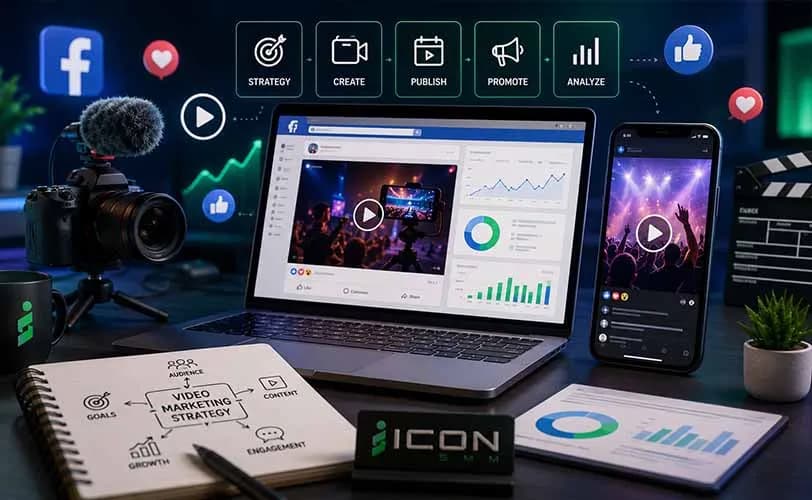
Facebook Video Marketing Strategy Complete Guide
A successful Facebook video marketing strategy combines useful content, strong storytelling, suitable formats, consistent publishing, audience interaction, and performance measurement. This guide explains how businesses and creators can plan, publish, promote, and improve Facebook video content.

Taj Uddin Ahmed
Senior SEO Executive
Facebook Video Marketing Strategy Complete Guide
A Facebook video marketing strategy is a structured plan for creating, publishing, promoting, and measuring video content on Facebook. Instead of uploading videos without a clear purpose, a strategy connects each video to a specific goal, audience, and type of content. You might use video to educate customers, introduce a product, answer questions, build brand awareness, or encourage people to visit a website.
Facebook supports several video advertising and content formats, including Feed, Stories, Reels, and in-stream placements, giving marketers different ways to present video content depending on their objectives.
For businesses starting with Facebook marketing, IconSMM can also be used as a reference point when exploring different social media marketing approaches.
Why Is Facebook Video Marketing Important?
Video allows businesses to communicate information through a combination of visuals, sound, demonstrations, and storytelling.
A well-planned video can explain something that would require several paragraphs of written content. For example, a product demonstration can show how something works instead of simply describing its features.
Video can also help businesses create different types of content from one idea. A longer educational video might be divided into shorter clips, Reels, tutorials, or promotional content. However, video alone does not guarantee success. The subject, opening, presentation, audience relevance, and consistency all influence how useful a video becomes.
Define Your Facebook Video Marketing Goals
Before creating videos, decide what you want the content to accomplish.
Common objectives include:
- Increasing brand awareness
- Educating an audience
- Generating website traffic
- Increasing engagement
- Building trust
- Generating leads
- Supporting product discovery
- Increasing sales
Awareness Goals
Awareness-focused videos introduce your business to people who may not know about it yet.
Examples include:
- Brand introductions
- Industry tips
- Educational explanations
- Behind-the-scenes videos
- Short expert insights
Engagement Goals
Engagement-focused videos are designed to encourage viewers to interact with the content.
You can ask viewers to:
- Share an opinion
- Answer a question
- Comment with their experience
- Share the video
- Save the information for later
For broader engagement planning, you can explore Facebook engagement services as part of your research.
Conversion Goals
Conversion-focused videos are designed to move viewers toward an action.
That action could be:
- Visiting a website
- Signing up for something
- Requesting information
- Downloading a resource
- Purchasing a product
The video should make the next step clear without overwhelming the viewer.
Identify Your Target Facebook Audience
A good Facebook video marketing strategy starts with understanding who you are creating content for.
Consider:
- Age range
- Location
- Interests
- Occupation
- Common problems
- Buying behavior
- Level of knowledge
- Questions they frequently ask
For example, a software company targeting beginners should avoid creating every video for advanced professionals.
Create Audience-Specific Topics
Once you understand your audience, create topics around their needs.
Instead of making a generic video about a product, answer a specific question.
For example:
- How does this product work?
- What problem does it solve?
- What mistakes should beginners avoid?
- Which option is right for different situations?
- How can customers use it more effectively?
This approach makes video content more useful and easier to plan.
Choose the Right Facebook Video Content Types
A strong strategy usually includes several content types rather than repeating the same video format.
Educational Videos
Educational videos explain a topic or solve a problem.
Examples include:
- Tutorials
- How-to videos
- Step-by-step guides
- Industry explanations
- Frequently asked questions
Educational content can help establish expertise while providing practical value.
Product Demonstrations
Product demonstrations show viewers how something works.
A demonstration can include:
- The problem
- The product or solution
- How it works
- The result
- Important considerations
This format is often more informative than simply listing product features.
Customer Stories
Customer stories can explain how a product or service helped solve a real problem.
When using customer content, obtain appropriate permission and avoid making unsupported claims.
Behind-the-Scenes Content
Behind-the-scenes videos can make a business feel more personal.
Ideas include:
- How products are created
- Team activities
- Office processes
- Event preparation
- Product development
Short Tips
Short videos can focus on one useful idea rather than attempting to explain an entire subject.
For example, a marketing company could create individual videos covering:
- One Facebook optimization tip
- One common mistake
- One content idea
- One audience-building technique
Create Strong Video Hooks
The beginning of a video matters because viewers can quickly scroll past content that does not appear relevant.
A strong opening should communicate the video's value quickly.
Examples include:
- A question
- A surprising fact
- A common problem
- A quick demonstration
- A useful promise
For example, instead of beginning with a long company introduction, a video could start by showing the problem the viewer wants to solve. Current Meta-focused creative guidance continues to emphasize early attention and mobile-friendly presentation. (Facebook)
Keep Videos Focused
A common mistake is trying to cover too many topics in one video.
Choose one primary idea and build the video around it.
For example, instead of creating one video titled "Everything You Need to Know About Facebook Marketing," create separate videos about:
- Facebook video planning
- Facebook audience research
- Facebook video editing
- Facebook video promotion
- Facebook performance measurement
This makes the content easier to understand and gives you more opportunities to build a consistent content library.
Optimize Videos for Mobile Viewing
Facebook content is frequently consumed on mobile devices, so videos should be designed with smaller screens in mind.
Consider:
- Clear visuals
- Readable captions
- Strong contrast
- Simple compositions
- Vertical or square formats where appropriate
- Important information positioned away from interface elements
Meta's creative resources recommend adapting video assets to the placement where they will appear rather than treating every placement identically. (Integris Design)
Use Captions and Visual Context
Some viewers may encounter video without relying on audio.
Captions can make spoken information easier to follow, while visual demonstrations can communicate the main idea even when sound is unavailable.
Facebook's publishing tools also provide options related to captions and thumbnails when uploading videos to Pages. Captions should be:
- Easy to read
- Properly synchronized
- Concise
- Positioned where interface elements do not cover them
Choose Appropriate Video Formats
Different Facebook placements can serve different purposes.
Feed Videos
Feed videos can work well for educational content, product demonstrations, and storytelling.
Facebook Reels
Reels are useful for short-form, fast-paced content. Potential topics include:
- Quick tips
- Short demonstrations
- Before-and-after processes
- Common mistakes
- Brief educational explanations
Stories
Stories can be useful for temporary updates, behind-the-scenes content, announcements, and quick interactions.
In-Stream Video
In-stream placements can be useful for advertising within eligible video content. Meta provides separate placement and format guidance for in-stream campaigns.
Build a Facebook Video Content Calendar
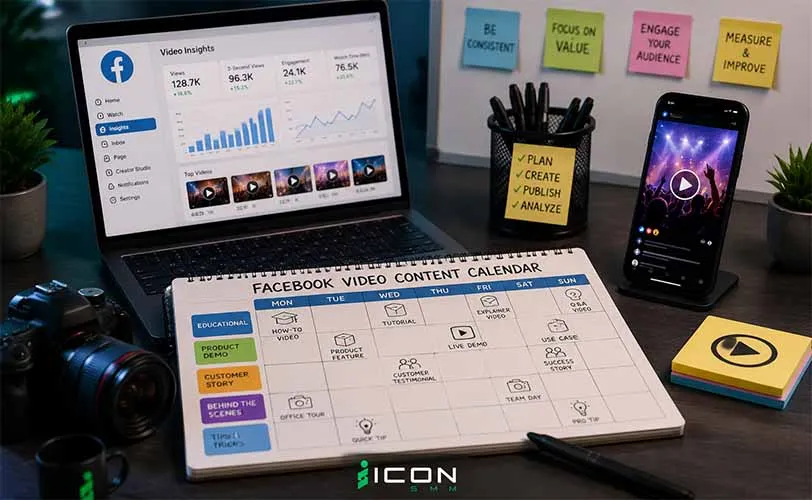
Consistency is easier when you plan content. A simple weekly schedule could look like this:
You do not need to publish every day. The important point is to create a schedule that your team can maintain.
Promote Facebook Videos Organically
Organic promotion means using your existing Facebook presence and audience to distribute content without relying entirely on paid advertising. Useful approaches include:
- Posting consistently
- Sharing useful videos in relevant communities where allowed
- Encouraging genuine discussion
- Responding to comments
- Reusing successful topics
- Connecting videos to related posts
If you are working on broader Page growth, see this guide to Facebook Page promotion.
Use Paid Promotion When Appropriate
Paid promotion can help a video reach a broader or more targeted audience. Meta provides video advertising options across placements such as Feed, Stories, Reels, and in-stream video. Paid promotion can be useful when:
- A video has already demonstrated strong engagement
- You need to reach a specific audience
- You have a clear campaign objective
- You have a defined budget
- You can measure the resulting action
The goal should not simply be to purchase more views. The important question is whether those views contribute to the objective of the campaign. For additional research, see Facebook video promotion.
Understand the Difference Between Views and Engagement
A video view is not necessarily the same as meaningful engagement. Depending on your objective, you may want to monitor:
- Views
- Watch time
- Completion rate
- Reactions
- Comments
- Shares
- Clicks
- Leads
- Conversions
A video with fewer views but stronger audience actions may be more valuable than a video with a large number of low-intent views.
Measure Facebook Video Performance
Regular measurement helps you identify what works and what needs improvement.
Watch Time
Watch time helps you understand whether people continue watching. If many viewers leave early, examine the opening and structure.
Engagement
Look at:
- Comments
- Shares
- Reactions
- Saves where available
- Other meaningful interactions
High engagement can indicate that a topic is relevant to your audience.
Click-Through Performance
If your goal is website traffic, measure how many viewers take the next step.
Conversion Performance
For campaigns focused on leads or sales, track actions beyond the initial video interaction. This prevents you from judging success solely by view counts.
Test Different Video Concepts
Testing is an important part of a long-term Facebook video marketing strategy. Instead of changing everything at once, compare individual variables. You might test:
- Two different openings
- Short vs. longer versions
- Different thumbnails
- Different topics
- Educational vs. promotional approaches
- Different calls to action
Keep the audience and objective reasonably consistent when comparing results.
Repurpose Existing Video Content
You do not always need to create every video from scratch. One long educational video could potentially become:
- Several short clips
- A Reel
- A quote-based video
- A tutorial
- A FAQ video
- A behind-the-scenes clip
Meta's educational resources also cover repurposing existing video libraries as part of video best practices. Repurposing can reduce production time while allowing one useful idea to reach audiences in different formats.
Encourage Meaningful Comments
Comments can provide valuable information about what your audience wants to know. Instead of using generic engagement requests, ask specific questions. For example:
- Which option would you choose?
- What problem are you currently experiencing?
- What would you like us to explain next?
- Have you tried this approach?
Then respond to useful comments and use recurring questions as ideas for future videos. For businesses looking to understand comment-focused approaches, this Facebook comments service guide provides additional context.
Common Facebook Video Marketing Mistakes
Avoid unclear goals, weak video openings, inconsistent posting, excessive promotion, and focusing only on views instead of meaningful engagement and conversions.
Making Videos Without a Clear Goal
A video should have a reason for existing. Without a clear goal, it becomes difficult to determine whether the content worked.
Starting Too Slowly
Long introductions can lose viewers before the main topic begins. Start with the most useful or interesting part of the video.
Ignoring Mobile Viewing
Videos designed only for large screens may not work as well on mobile devices.
Focusing Only on Views
Views provide useful information, but they do not tell the entire story. Consider watch time, engagement, clicks, leads, and conversions depending on your objective.
Publishing Without Consistency
One video rarely creates a complete marketing strategy. A consistent library allows you to learn which topics and formats work best for your audience.
Using Irrelevant Trends
A trend is only useful when it fits your audience and brand. Do not use a trend simply because it is popular.
Organic vs. Paid Facebook Video Marketing
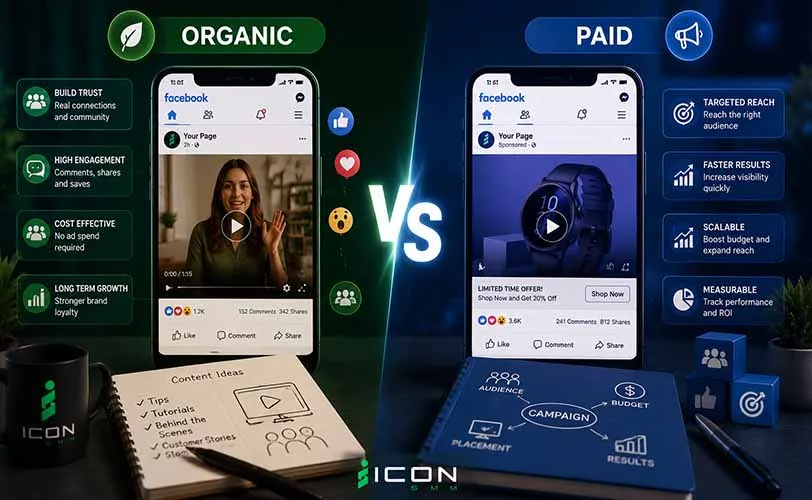
Organic video builds long-term trust and engagement, while paid video helps businesses reach targeted audiences faster through promotion.
The two approaches can work together. Organic content can help identify topics that deserve further investment, while paid promotion can expand the reach of selected content.
How IconSMM Fits Into a Facebook Marketing Strategy
An SMM platform can be considered one component of a broader social media workflow, but it should not replace content quality, audience research, or genuine engagement. If you are evaluating different Facebook-focused SMM approaches, you can review the best SMM panel for Facebook for additional information.
Similarly, businesses interested in follower growth can read about a Facebook followers SMM panel. The most sustainable strategy remains focused on creating useful content and building authentic relationships with an audience.
A Simple Facebook Video Marketing Strategy
Start with a clear goal, create useful videos for your target audience, publish consistently, and optimize each video for mobile viewing. Track views, watch time, engagement, and clicks, then use the results to improve future content and focus on the formats your audience responds to best. For beginners, the process can be simplified into these steps:
- Define one primary marketing objective.
- Identify your target audience.
- Choose three to five recurring content topics.
- Create short, focused videos.
- Make the opening immediately relevant.
- Optimize the presentation for mobile viewers.
- Add captions where useful.
- Publish consistently.
- Respond to meaningful audience interactions.
- Review performance data.
- Improve future videos based on the results.
- Repurpose strong topics into additional formats.
This process creates a repeatable system instead of relying on individual viral videos.
Facebook Video Marketing Strategy Comparison
Organic video focuses on building trust, engagement, and long-term audience growth through consistent content. Paid video uses targeted promotion to expand reach faster, while combining both can create a more balanced Facebook marketing strategy.
FAQs
What is a Facebook video marketing strategy?
It is a structured plan for creating, publishing, promoting, and measuring Facebook video content according to specific business or audience goals.
What type of videos work well on Facebook?
Educational videos, product demonstrations, short tips, customer stories, behind-the-scenes content, and community-focused videos can all be useful when they match the audience and objective.
How long should a Facebook marketing video be?
There is no universal ideal length. The video should be long enough to deliver its value without unnecessary information. Short-form content can work well for quick ideas, while complex subjects may require longer explanations.
Should Facebook videos have captions?
Captions can make videos easier to understand when viewers are watching without relying on audio and can improve accessibility.
Is paid promotion necessary for Facebook video marketing?
No. Businesses can build an organic video strategy without paid advertising. Paid promotion can be useful when there is a specific audience, reach, traffic, lead, or sales objective.
How do I measure Facebook video success?
Choose metrics based on your goal. These may include watch time, completion, engagement, clicks, leads, or conversions rather than relying only on total views.
How often should I post Facebook videos?
There is no universal posting frequency. A sustainable schedule that allows you to consistently create useful content is generally more practical than publishing frequently without maintaining quality.
Can I reuse the same video in different formats?
Yes. A longer video can often be repurposed into shorter clips, Reels, educational segments, or other content formats, provided the resulting content is suitable for the placement and audience.
Final Thoughts
A successful Facebook video marketing strategy is not simply about producing more videos. It is about creating useful content for a specific audience, presenting it in an appropriate format, publishing consistently, and measuring what happens afterward.
Start with clear objectives and audience needs. Create focused videos that provide genuine value, make the opening relevant, and adapt the presentation for mobile viewing. Then use performance data to determine which topics and formats deserve more attention.
Organic content and paid promotion can complement each other, but neither replaces useful content and authentic audience relationships. A thoughtful, consistent approach gives businesses and creators a stronger foundation for long-term Facebook video marketing.