What Is Child Panel in SMM Panel Complete Starter Guide
A child panel in an SMM panel is a separate reseller panel connected to a main SMM panel, allowing users to sell social media services under their own brand. This starter guide explains how child panels work, their benefits, setup process, pricing, and what beginners should know before using one.

Taj Uddin Ahmed
Senior SEO Executive
If you are researching what is child panel in smm panel, you are probably considering an easier way to enter the social media marketing business without developing a complete platform from scratch.
A child panel gives resellers, agencies, freelancers, and entrepreneurs their own branded SMM storefront while relying on a larger provider for much of the backend service delivery.
The model sounds simple, but choosing the right setup requires understanding who controls the services, how orders move between panels, what costs are involved, and where your profit actually comes from.
This guide explains each of those areas so you can decide whether a child panel fits your business goals.
What Is an SMM Child Panel?
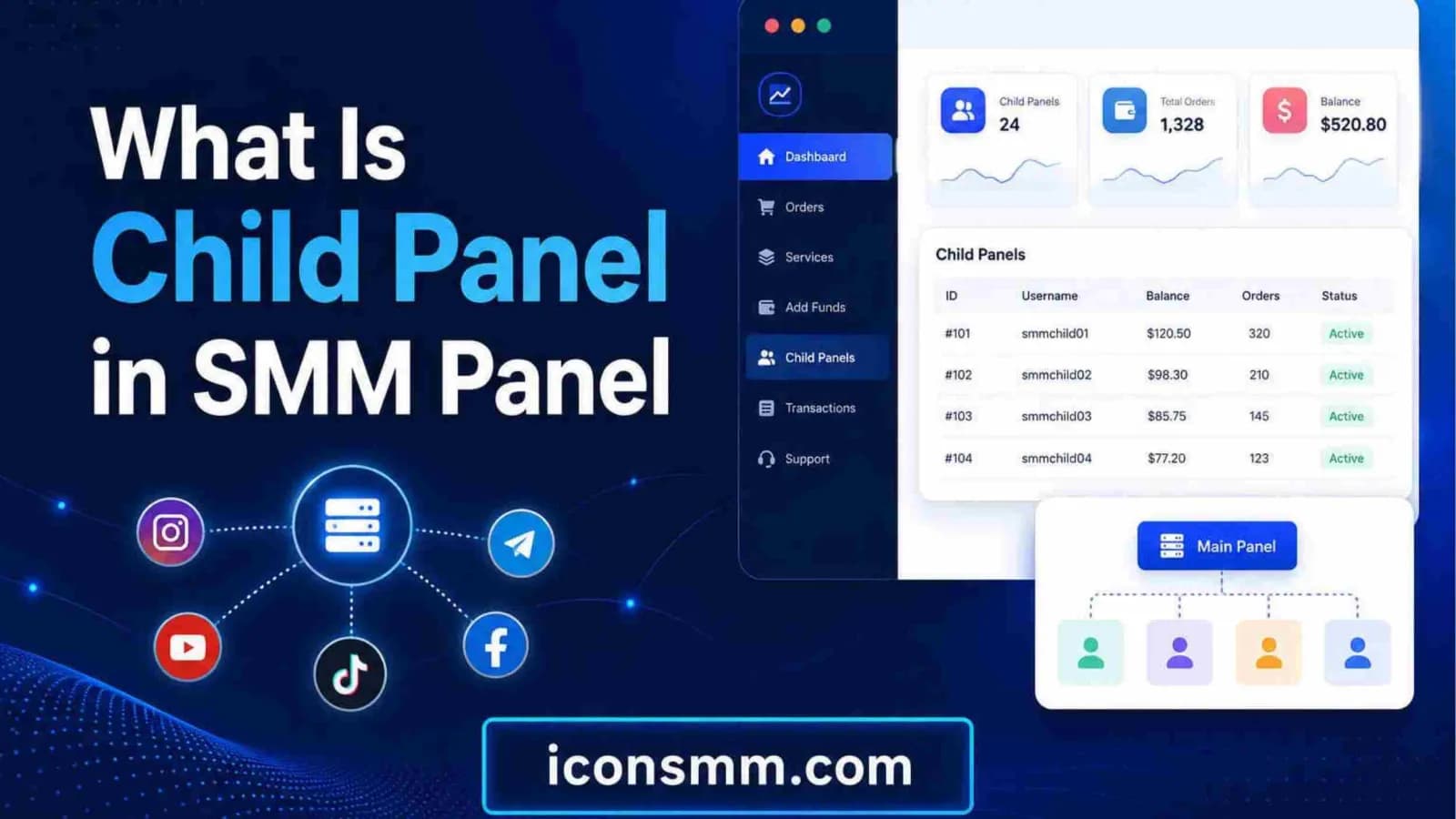
An SMM child panel is a reseller-focused SMM website connected to a larger panel, normally called the parent panel or main panel.
The child-panel owner can usually operate with a separate domain, branding, service prices, customer accounts, and order dashboard while receiving services through the parent system.
The easiest way to understand the child panel meaning in SMM is to separate the storefront from the supply system. Your customers interact with your website and brand, while the underlying services are supplied or routed through the parent panel.
Instead of spending heavily on custom software, server infrastructure, provider integrations, and order automation, the reseller can concentrate on attracting customers, setting prices, supporting users, and building a recognizable brand. Understanding that separation makes the order process much easier to follow.
How Does a Child Panel Work?
To understand how does a child panel work, imagine a normal online store where one company owns the storefront while another company supplies the products.
An SMM child panel follows a similar structure, except social media marketing services are handled digitally through connected systems.
A typical order may move through these steps:
- A customer creates an account on the child panel.
- The customer adds funds to their balance.
- They choose an available social media service.
- The reseller's retail price is displayed.
- The customer submits the required profile, post, video, or page URL.
- The order is routed to the parent panel or connected provider.
- The service is processed.
- Order status information appears in the customer's dashboard.
Automation is one of the major reasons entrepreneurs choose this model. Instead of manually transferring every order, API-based connections can reduce repetitive administrative work and make larger order volumes easier to handle.
However, automation does not remove responsibility from the reseller. The child-panel owner still needs to manage customers, pricing, service descriptions, support questions, payment issues, and expectations.
That division of responsibility becomes especially important when comparing child and parent panels.
Child Panel vs Parent Panel: What Is the Difference?
The child panel vs parent panel comparison is mainly about ownership of infrastructure and responsibility for service fulfillment.
A parent panel normally sits higher in the supply chain, while the child panel operates as a customer-facing reseller business.
In simple terms, the parent provides the engine while the child panel operates the branded storefront.
This means your customers may never interact with the parent company directly. They judge your business based on your pricing, website, support, and overall experience, even when the actual service originates elsewhere. That is why provider selection becomes a major business decision rather than simply a technical choice.
Child Panel vs Main Panel
The child panel vs main panel difference is similar to the parent-panel comparison, but the phrase "main panel" is often used more broadly for the primary SMM platform from which resellers purchase services.
A main panel may have direct provider integrations, multiple API sources, larger service inventories, technical management tools, and wholesale pricing. A child panel is normally more focused on retail sales and customer acquisition.
Neither option is automatically better. Someone with technical resources and an established customer base may eventually want greater control, while a beginner may prefer the lower entry barrier of a child panel.
Knowing where you want your business to go helps determine whether starting small through a reseller structure makes sense.
Child Panel vs Reseller Panel

The terms child panel vs reseller panel are sometimes used interchangeably, but they can describe slightly different setups depending on the provider.
A basic reseller account may simply allow you to purchase SMM services at wholesale rates and resell them manually to your own customers. Your customers might never receive access to their own ordering dashboard.
A child panel usually gives you a more complete branded environment. Customers can potentially register, deposit funds, browse services, submit orders, and check progress directly from your website.
For example, a reseller might create packages around Facebook video promotion instead of selling a generic service with no context. The reseller controls how the offer is positioned to customers even though the fulfillment infrastructure may come from another source.
This ability to build your own customer experience is one of the reasons a child-panel model can be more scalable than manual reselling.
What Can You Control Inside a Child Panel?
Although features depend on the provider, a child-panel owner may be able to control several customer-facing parts of the business.
These can include:
- Brand name and logo
- Domain or subdomain
- Retail service prices
- Service categories
- Service descriptions
- Customer accounts
- Support communication
- Promotions
- Profit margins
- Deposit methods
- Order visibility
The exact level of customization should always be checked before purchasing a panel.
Resellers can also use educational content to make their offers more useful. For instance, explaining Facebook engagement rate can help customers understand that social media performance involves more than simply increasing visible numbers.
Once your storefront and positioning are clear, the next major question becomes how much the operation will cost.
How Much Does an SMM Child Panel Cost?
There is no universal SMM child panel price because providers use different billing models. Some charge a recurring monthly fee, while others may require setup charges, domain expenses, deposits, or additional fees for specific features.
Your total operating cost can include:
Someone searching for a cheap SMM child panel should therefore compare the total cost rather than looking only at the advertised setup price.
A very inexpensive panel can become costly if it has poor uptime, weak support, unreliable services, or limited functionality. Sustainable pricing should consider both affordability and operational quality.
Is an SMM Child Panel Profitable?
People frequently ask, is SMM child panel profitable, and the practical answer is that profitability depends on your margins, customer volume, expenses, and retention.
Suppose a parent service costs you $1 and you sell it for $1.50. Your gross difference is $0.50, but that is not necessarily your final profit.
Payment processing fees, refunds, marketing costs, customer support, and other expenses may reduce the amount you actually keep.
A healthier calculation is:
Net Profit = Customer Revenue − Service Cost − Payment Fees − Marketing Costs − Support and Operating Expenses
This is why simply adding a large markup does not automatically create a successful business. Customers compare price, delivery expectations, support quality, and available services before deciding where to order.
Strong resellers focus on repeat customers and sustainable margins rather than maximizing profit on every individual order.
How to Choose a Parent Panel for Child Panel Operations

Understanding how to choose a parent panel for child panel operations is one of the most important parts of launching your business. Your brand reputation can be affected by systems and services that customers cannot see.
Before selecting a provider, examine the following areas carefully.
1. Service Stability
Check whether commonly used services remain available consistently. Frequently disabled or unstable services can make it difficult to maintain a reliable catalog.
2. Pricing Structure
Low wholesale pricing can improve margins, but price should not be the only consideration. Compare service characteristics, minimum quantities, refill terms, and order limitations.
3. API and Automation
If your operation depends on automatic routing, stable technical connectivity matters. Delayed updates or connection problems can increase manual work.
4. Support Responsiveness
Customers will contact you when something goes wrong. You need a parent provider capable of helping you investigate order problems efficiently.
5. Service Information
Clear descriptions help resellers set realistic expectations. Avoid presenting every service as identical when speed, retention, refill policies, and targeting options may differ.
6. Payment Convenience
Your ability to maintain sufficient panel balance directly affects whether customer orders can continue without interruption.
A reseller-friendly SMM panel should be assessed based on service availability, usability, order management, pricing, automation options, and support rather than a single promotional claim.
Once you have identified several potential providers, comparing them with a consistent checklist makes the purchasing decision much safer.
What to Check Before You Buy an SMM Child Panel
Before you buy SMM child panel access, request clear information about what is actually included. Do not assume every child-panel package offers the same functionality.
Ask about:
- Whether a custom domain is supported
- How branding can be customized
- Whether services synchronize automatically
- Whether you can change retail prices
- How order statuses are updated
- What happens when a parent service is disabled
- Whether refill and cancellation statuses are synchronized
- How customers add funds
- What support channels are available
- Whether there are additional monthly charges
Also examine the experience from your future customer's perspective. A complicated ordering process, unclear service descriptions, or poor support can reduce repeat business regardless of how inexpensive the services are.
The goal is not merely to own a panel. The goal is to operate a customer-friendly reseller business.
How to Find the Best Child Panel Provider
The best child panel provider is not necessarily the company advertising the lowest monthly price. The better choice is the provider whose infrastructure, service catalog, support standards, pricing, and technical capabilities fit your intended business model.
Start with a small evaluation instead of committing significant funds immediately. Explore the dashboard, inspect service descriptions, test support responses, and place controlled orders where appropriate.
You should also consider the kinds of customers you plan to serve. An agency managing video campaigns may care about completely different services from a reseller serving creators or local businesses.
For example, customers interested in video performance may also need guidance on Facebook watch time optimization. Building useful information around the services you sell can differentiate your panel from competitors that only display large service lists.
Provider selection creates the foundation, but your positioning determines whether customers have a reason to choose your brand.
How to Start Your Own SMM Panel Business
A child-panel structure can make it easier to start your own SMM panel business because you do not need to develop every technical component independently.
A practical starting process looks like this:
Step 1: Choose Your Target Market
Decide whether you want to serve creators, small businesses, agencies, freelancers, local customers, international users, or other resellers.
Step 2: Select a Reliable Parent Provider
Evaluate service stability, pricing, automation, support, and terms before building your brand around the platform.
Step 3: Create Your Brand
Choose a memorable brand name, suitable domain, clear logo, and consistent visual identity.
Step 4: Build Your Service Catalog
Do not automatically publish every available service. Organize the services most relevant to your audience and write understandable descriptions.
Step 5: Set Sustainable Prices
Calculate the wholesale cost, transaction fees, operating expenses, and desired margin before setting retail prices.
Step 6: Prepare Customer Support
Create clear procedures for pending orders, partial orders, refills, cancellations, refunds, and common customer questions.
Step 7: Market the Business
Use SEO content, social media, partnerships, communities, paid advertising where appropriate, and educational resources to attract relevant customers.
The technology may help you launch, but long-term growth will depend more heavily on trust, service management, positioning, and customer retention.
Advantages and Limitations of an SMM Child Panel
A child panel can lower the technical barriers to entering the SMM market, but it also introduces dependency. Looking at both sides gives you a more realistic picture.
The model works best when the reseller understands those trade-offs before investing.
A child panel is therefore a business tool rather than a guarantee of income. What you build around the tool matters more than simply having access to it.
Final Words
If your original question was what is child panel in smm panel, the simplest answer is that it is a branded reseller SMM panel connected to a larger parent or main panel.
You manage your customers, branding, pricing, marketing, and front-end business experience, while the parent system generally supplies or routes the services behind the scenes.
For entrepreneurs who want to enter the SMM market without developing a complete platform from zero, the model can reduce startup complexity.
However, success still depends on choosing a dependable parent provider, understanding costs, creating realistic pricing, providing responsive support, and building customer trust.
Treat a child panel as the infrastructure for your business—not the business itself. The stronger your service selection, positioning, customer experience, and operational discipline become, the better your chances of turning that infrastructure into a sustainable reseller brand.
Frequently Asked Questions
What is a child panel in an SMM panel?
A child panel is a branded reseller website connected to a parent SMM panel. The reseller manages customers, pricing, branding, and marketing while the parent system generally handles or routes service fulfillment.
How does an SMM child panel work?
Customers place orders through the child panel, and those orders are typically transferred to the parent panel through an automated connection. The parent processes the service while order information is reflected back in the child-panel dashboard.
Is a child panel the same as a main SMM panel?
No. A main panel generally has greater control over provider connections, infrastructure, and service delivery. A child panel relies on the main or parent panel for much of that backend functionality.
What is the difference between a child panel and a reseller account?
A normal reseller account may require you to place orders manually for customers. A child panel usually gives customers access to your own branded website where they can register, add funds, order services, and track their orders.
How much does an SMM child panel cost?
The cost varies by provider and may include panel fees, domain costs, service balance, payment processing, branding, and other operating expenses. Compare total business costs rather than choosing a provider based only on the lowest advertised price.
Can an SMM child panel be profitable?
It can generate profit when the reseller maintains sufficient margins, controls operating costs, attracts customers, and encourages repeat purchases. Profit is not guaranteed because marketing, payment fees, refunds, service costs, and support expenses must also be considered.
What should I look for before buying an SMM child panel?
Evaluate parent-panel reliability, service quality, pricing, API stability, customization, support, refill policies, payment options, service descriptions, and order management features. A strong parent relationship is important because backend problems can directly affect your customers.